
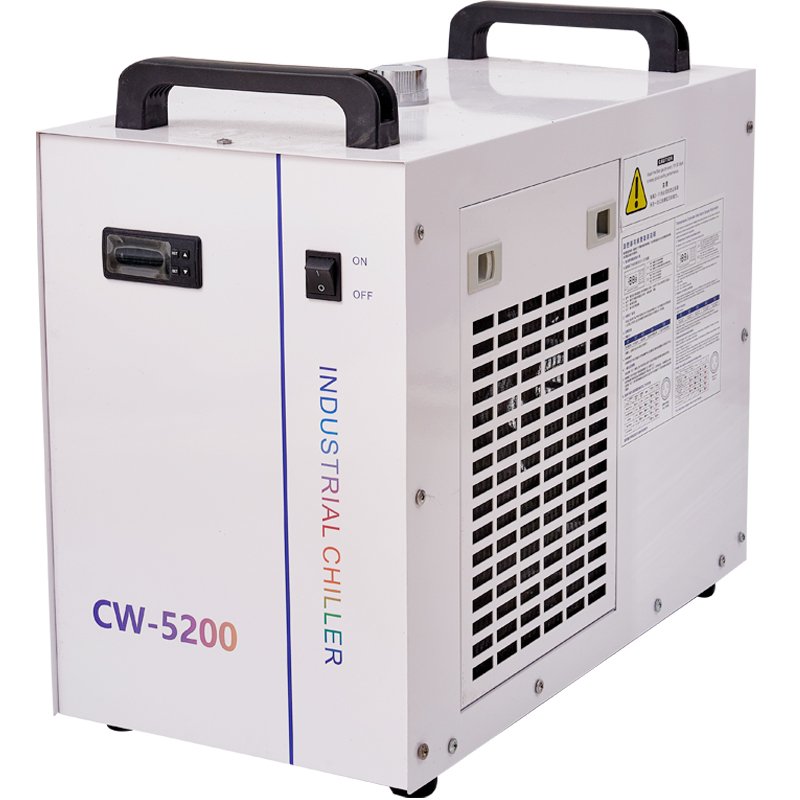
A Practical Guide to Industrial Chiller Specs (And How to Choose the Right One)
Whether you’re running injection molding lines, laser cutters, or high-end lab equipment, your Industrial Chiller is the backbone of your production. If it fails or underperforms, everything stops. But looking at a spec sheet can be a headache if you aren’t an HVAC engineer.
Instead of getting lost in the jargon, let’s look at the real-world parameters that actually matter when you’re ready to buy.
1. Cooling Capacity: Don’t Cut it Too Close
This is your “cooling power.” It’s usually measured in kW or Tons (RT). While there’s a standard formula ($Q = m \cdot C_p \cdot \Delta T$), real-world conditions are rarely perfect.
The Golden Rule: Always size your chiller with a 20% safety margin. If your process generates 10kW of heat, don’t buy a 10kW chiller. Buy a 12kW unit. This accounts for hot summer days, dirty filters, and the natural aging of the machine.
2. Temperature Range & Your Process
Most standard units run between 5°C and 35°C. That works for 90% of industrial applications. However, if your setup requires “ice water” or sub-zero temperatures, a standard water chiller won’t cut it—you’ll need a Glycol (Brine) Chiller to prevent the lines from freezing up.
3. Pump Flow and Head (The “Push”)
You can have the most powerful chiller in the world, but if the pump can’t get the water to your machine, it’s useless.
- Flow Rate: Is the water moving fast enough to carry the heat away?
- Pump Head: Can the pump push water through all your pipes, bends, and up to that second-floor mezzanine? If your “head” is too low, you’ll constantly hit low-flow alarms.
4. Choosing Your Compressor
Think of the compressor as the heart of the system. Your choice usually depends on the size of your operation:
| Type | Best For… | The Upside |
|---|---|---|
| Scroll | Small to medium jobs | Quiet, reliable, and very few moving parts. |
| Screw | Heavy-duty / Large scale | Extremely efficient and handles varying loads well. |
5. Air-Cooled vs. Water-Cooled: Which is better?
It depends on your facility.
- Air-Cooled: These use fans (like a giant car radiator). They are “plug and play” and don’t need a cooling tower. Great if you’re short on space or water.
- Water-Cooled: These need an external cooling tower. They are much more efficient for big operations, but they require more maintenance and a steady water supply.

6. The “Hidden” Efficiency: Electronic Expansion Valves
If you want to save on your electricity bill, look for a chiller with an Electronic Expansion Valve (EEV). Older models use mechanical valves that are “dumb.” EEVs adjust in real-time to exactly how much cooling you need, which can cut energy costs by 15% or more.
